DENSE ACCUMULATED POWER ELECTROMAGNETIC RADIATION (DAPER)
Capture the sun.Transmit energy anywhere
PERA-Fiber is pioneering a new class of optical energy infrastructure that captures solar irradiance at source and transports it over long distances as directly usable light and thermal energy.
86.5%
Transmission efficiency
For distances below 500 km; 85.5% above 500 km
>85%
Solar spectrum captured
Including diffuse and indirect sunlight
TRL 4
Scalable lab prototype
Demonstrated at the Fraunhofer Institute, Germany
82/100
Independent feasibility score
Third-party due diligence assessment
The constraint
Renewable energy is abundant,
but access to it is not
Traditional solar generation remains tied to the location, timing and intensity of incident sunlight. Large-scale deployment also depends on land, storage, transmission capacity and lengthy grid interconnection processes.
Illustrative · not to scale
The solution
Multiple suns, delivered anywhere
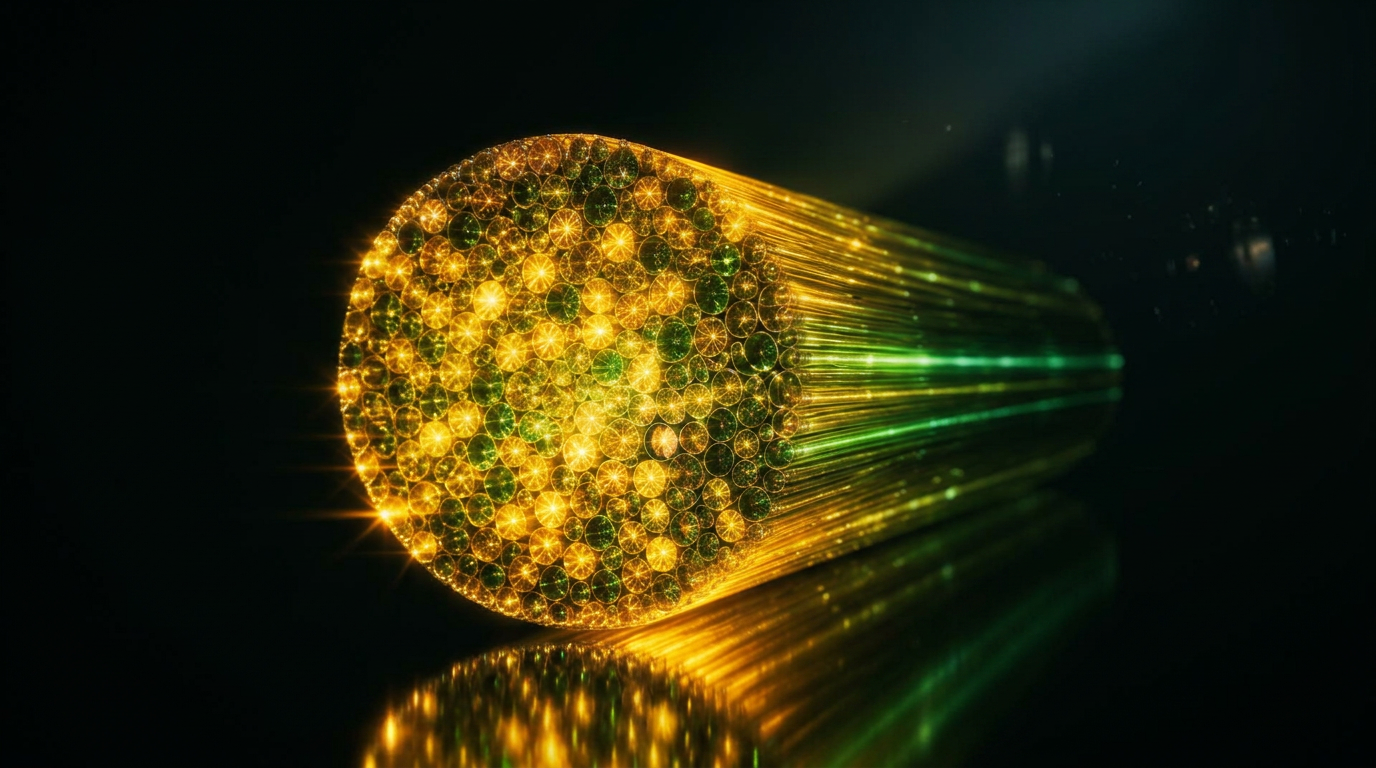
PERA-Fiber turns solar irradiance into a transportable optical stream. Instead of converting sunlight into electricity where it lands and forcing it through congested grids, the energy stays as accumulated light — guided over long distances through engineered fibre to the place, and in the form, where it is actually needed.
3D nanostructured optical surfaces are designed to collect more than 85% of the incident solar spectrum, from any angle of incident light.
Energy travels through the fibre as accumulated photonic energy — not as electrons through copper — with projected transmission efficiency of 86.5% below 500 km.
At the destination, the light is converted into whatever the process requires: high-temperature industrial heat, electricity, hydrogen, thermal storage, or tailored light for solar-driven applications such as solar fuels, green desalination, green hydrogen, and wavelength-specific lighting for vertical farming.
One infrastructure that moves energy the way light already moves: fast, dense and direction free.
A PERA COMPLEXITY COMPANY
Explore PERA-Fiber
- 01
Technology
Nanostructured optical conduits designed to capture, accumulate and transmit solar irradiance as usable light and heat.
- 02
Applications
Industrial heat, remote delivery and tailored conversion — light becomes the energy format each system needs.
- 03
Science
Rooted in complexity science, built through photonics and advanced materials research at PERA Complexity.